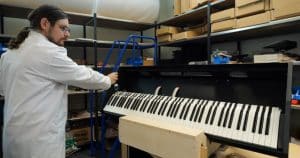

Before finding a home with a musician, every Phoenix comes to life in our workshop in Vénissieux, near Lyon. Behind every instrument lie precise craftsmanship, time, and the faces of the people who made it.
Assembly: precision comes before sound.
Sébastien, head of mechanical design and production, assembles each piano piece by piece. More than 90 components go into the construction of a Phoenix, and it takes nearly eight hours to complete the assembly. His goal is simple: to ensure the instrument’s mechanical and acoustic integrity.
Assembly is a key step. Each part is carefully aligned and secured to ensure a perfectly stable structure. Incorrect positioning or improper tightening could disrupt the transmission of vibrations. This stability is essential for preserving the clarity and quality of the sound.
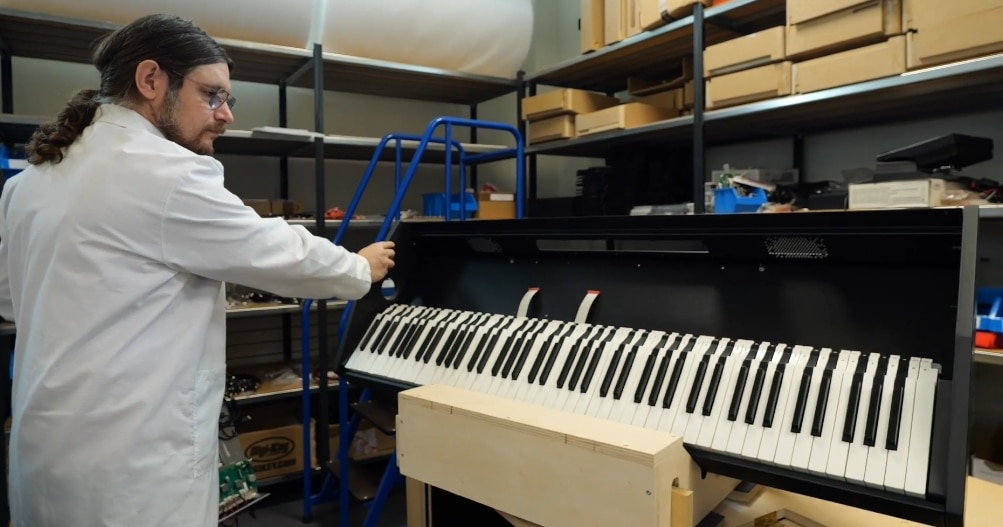
“During assembly, every torque setting for the screws is important, as are the routing points for the internal cables. These factors can significantly affect the piano’s sound quality.”
Even before the first note sounds, precision is already at work.
Calibration: an essential step.
Once assembly is complete, Charlie, a sound engineer at Phoenix, takes over. His job is to prepare and calibrate each Phoenix individually.
Charlie carefully adjusts the amplifiers and the tonal balance of the various channels. He tests and breaks in the speakers and ensures that the electronic systems, inputs and outputs, connections, and the overall sound quality of each Phoenix are functioning properly.
“A musical instrument is, in a sense, the physical and sensory extension of the musician. It must step back as an interface to become the most direct possible vehicle for the musical message and intention. Any inconsistency can be perceived as an obstacle, which is why these tuning stages are essential and constantly evolving: I pay particular attention to listening to the feedback, requests, and critiques of each pianist in order to offer an instrument and a follow-up that are virtually ‘tailor-made.’”
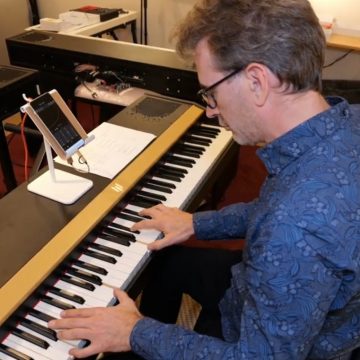
Charlie fine-tunes every key on the keyboard with precision—balancing the dynamics and ensuring a consistent response—to optimize the interaction between touch and sound. This meticulous calibration, as the final step in the preparation of each Phoenix, allows the pianist to establish a genuine bond of trust with their instrument.
Locally made with a commitment to sustainability.
Each piano is assembled in Vénissieux, with more than 70% of its parts manufactured in France, a significant portion of which are produced in the Auvergne-Rhône-Alpes region. This approach allows us to maintain close ties with our partners and closely monitor every stage of the design and production process.
Beyond the technology, the craftsmanship behind a Phoenix relies on the team’s patience, attentiveness, and expertise. The goal remains the same: to design an instrument capable of bridging the gap between the acoustic and digital worlds while preserving the pianist’s musical expressiveness and emotion.